Chicken, Apricot & Almond Pie

The main ingredient that I was trying to use up this week was a packet of Filo pastry that had been in my freezer just a bit too long, after struggling to fold some rather flaky and dry sheets of Filo into a parcel shape, in my Wild Mushroom Parcel Recipe, I didn’t really want to attempt to make some planned chicken parcels.

I was at a loss of what to do with the remaining pastry but as I already had the chicken & apricot filling planned I thought that instead of making a parcel I would create a pie by topping the dish with crushed up filo pastry.

I had some dried apricots left over from a recent baking attempt and I know that apricot and chicken can work quite well together, hence the inspiration for the recipe that follows:

INGREDIENTS

  • 1 x tbsp. Olive Oil
  • 2 x Chicken Breasts diced
  • 1 x Onion finely chopped
  • 1 x Garlic Clove crushed
  • 3 x Dried Apricots finely chopped
  • 200ml Crème Fraiche/Cream
  • 200ml Chicken Stock
  • Dash White Wine (Optional)
  • 2 x Sheets Filo Pastry
  • Small handful of Flaked Almonds (Optional)

METHOD

Preheat oven to 180c (Fan)

Heat 1 tbsp.  Olive oil in a large frying pan over a medium heat

Add onion and garlic and cook for 3 minutes

Add chicken and cook for a further 5 minutes until browned

Add chopped apricots and cook for a further minute

Add dash of white wine if using (a dash of water or stock will do just fine if not, I used a couple of white wine ice cubes that I’d made previously from the remnants of a bottle of wine) and scrape the bottom of the pan to incorporate all the lovely flavours

Add stock and simmer until the liquid has reduced by half.

Finally add the cream, stir and season well. Continue to cook on the hob for 5-10 minutes, until sauce has thickened slightly

Meanwhile flake the two sheets of filo pastry, I did this by putting the sheets into a plastic freezer back and crushing with my hands

Remove the mixture from the heat and fill a greased pie-dish, top with the flaked filo pastry and for a bit of extra crunch sprinkle over a few flaked almonds

20140323-185222.jpg Sprinkle with milk or egg to ensure that the topping will turn a nice golden brown (I used a pastry brush and flicked it over the pie, you’ll find you’ll be unable to brush it as the flakes of pastry will stick to the brush)

Bake in oven for 15-20 minutes or until the topping of pie turns golden brown.

TIPS

Fresh Apricots would work well (if not better) I’d recommend just reducing the number as my pie was quite sweet.

The measurements of stock and cream are estimates, as a general rule, ensure all of the ingredients are just covered by the liquid.

If you add too much liquid, corn flour is a great way to thicken up a sauce.

If you don’t want to make a pie and are better at working with filo pastry than I am, you could make small individual parcels.

20140323-191126.jpg

Wild Mushroom Parcels

One of the ingredients I had to use up in this weeks batch cooking attempt was a packet of Filo pastry that had been festering in my freezer for a bit too long.

I generally find Filo pastry really difficult to work with and I also find that it doesn’t freeze very well despite the packet recommending that it’s perfectly fine to keep frozen for up to a month.

Searching through my cupboards and freezer I discovered that had some leftover dried porcini mushrooms, dried apricots, some chicken breasts and some flaked almonds. From these ingredients I decided two dishes that I could cook up were some Wild Mushroom Parcels and a Chicken, Apricot & Almond Pie (recipe to follow).

The only additional ingredients that I needed to buy to enable me to create both of these dishes were some cream (or I used Crème Fraiche), a packet of button mushrooms and an onion. And here is how I created the Filo Mushroom Parcels.

INGREDIENTS

  • 4 x Sheets Filo Pastry
  • 6 x Porcini Mushrooms (Soaked and Chopped)
  • 300g Button Mushrooms (Washed & Sliced)
  • 1 x Onion (Finely Chopped)
  • 200ml Crème Fraiche or Cream
  • 2 x Garlic Cloves (Crushed)
  • Dash of Stock or White wine (optional)
  • Knob of Butter
  • Parsley (Dried or Fresh)

METHOD

Soak Porcini mushrooms according to the packet instructions (save water for later).

Preheat oven to 180c

Heat butter over a medium heat in a saucepan; once melted, add the chopped onion and garlic and cook for 5 minutes or until the onions soften and become translucent.

Add in chopped button and Porcini mushrooms and continue to cook for a further five minutes.

Once mushrooms have started to soften, add in a dash of stock or white wine (I used frozen wine ice cubes that I’d made from left-over wine) and continue to cook the mushrooms over a low heat until the stock has reduced by half.

Add in 200ml cream (or Crème Fraiche) and some parsley, cook the mushroom mixture for a further 10-15 minutes, until the sauce has thickened and become a rich brown colour. For additional richness you can add in some of the water used to soak the Porcini mushrooms.

Season to taste before removing the mixture from heat and allowing to cool slightly.

Fold the Filo pastry into a triangular shape and place 2-3 tbsps (depending how big you want your parcels to be) of the mushroom mixture in the centre of the pastry.

20140318-212839.jpg

Fold the corners of the triangle into the centre to create a parcel and brush with milk or egg to seal.

Place the parcels in the pre-heated oven and cook for 15-20 mins until golden brown.

TIPS

You don’t have to use Porcini mushrooms if not available, normal mushrooms will do just fine.

Why not add some chilli flakes or bacon for additional flavour.

If you don’t have Filo pastry, the filling would also taste great with puff pastry or topped on a bruschetta with a sprinkle of Parmesan for some cheesy goodness.

The cooked parcels can be frozen and reheated at a later date.

As mentioned at the beginning of my post, I find Filo pastry incredibly difficult to work with and probably will refrain from buying it in future and I’ll definitely avoid freezing it.  Due to the crumbliness of the pastry I struggled to actually form a parcel so the finished product looked a bit misshapen. I certainly wouldn’t win any points on Masterchef for presentation, but the parcels tasted great and I managed to get rid of a couple of ingredients that had been lurking in my cupboards/freezer for a bit too long.

20140318-212905.jpg

Sausage, Chilli & Tomato Pasta

This week I’m home alone; when I’m home alone I never want to spend much time cooking so I prefer to make a couple of dishes that will serve me over multiple meal times.

I’ve had a rather extravagant January and with the Christmas costs still hanging over me, I’m determined to have an economising month. My mission during February is to literally empty the cupboards and freezer and buy as little as possible from the supermarket.

Last week I’d frozen some leftover tinned tomatoes and some fresh red chillies; also lurking in the bottom of my freezer were some pigs in blankets that I hadn’t used up over Christmas. I couldn’t think of a use for the pigs in blankets other than on the side of a roast, but I figured that they’re just sausages and bacon so why not use them up just as I would normal sausages.

Pasta’s great for using up leftovers, it’s amazing what you can do with tinned tomatoes and a few veggies, there’s no need to buy expensive jars of pasta sauce. As I was using up ingredients I had in the freezer and cupboard I didn’t have to visit the shop for this recipe as there was also a half eaten onion lurking in my fridge.

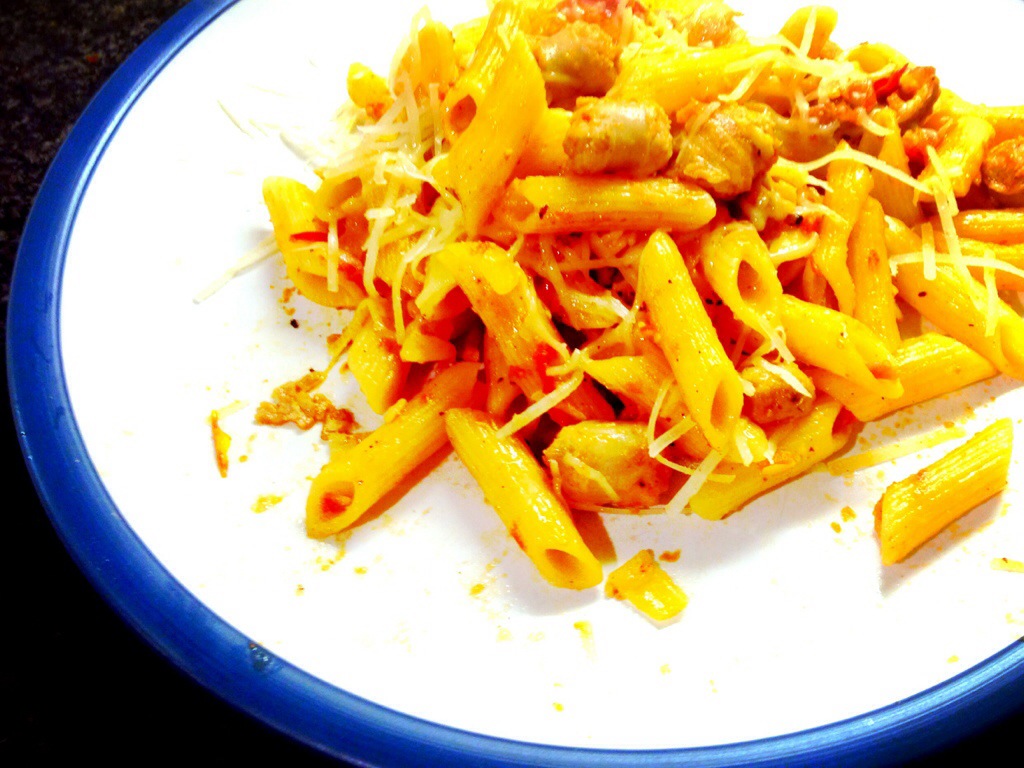
And this is how the ingredients below, provided me with couple of dinners and a lunch for the week (there would have been 4 portions but I didn’t have quite enough pasta in) meaning that I didn’t have to slave in the kitchen every night after work.

20140209-145324.jpg

INGREDIENTS

  • 6 Sausages (I used pigs in blankets as a substitute)
  • 200g Tinned Tomatoes
  • 200-300g Pasta (50-75g a portion)
  • 1/2 Onion
  • 1 Red Chilli (or pinch of dried chilli flakes)
  • 1 Garlic Clove
  • 1 tbsp Olive Oil
  • Dash White Wine (optional)
  • Parmesan to top (optional)

METHOD

Heat oil in large frying pan and fry chopped onions and garlic for 3-4 minutes until soft

Add sausages and fry for 5-6 minutes until browned

Add dash of white wine (water or stock will do if you don’t have wine) and scrape the bottom of the pan (this step will add additional flavour to the sauce). Boil over a high heat for a few minutes, until the liquid has reduced by a third.

Add in the tinned tomatoes and chopped red chilli, bring to the boil and then simmer for 10 minutes or until the sausages are cooked through.

Meanwhile cook the pasta according to the instructions. Once cooked and drained, combine with the sausage mixture and top with grated cheese if desired.

20140209-144026.jpg

TIPS

Note I used frozen fresh red chillies for this recipe; I’ve found the best way to freeze chillies is to chop before freezing. I’ve frozen chillies whole before but they tend to retain too much water when defrosted.

The dash of white wine I used was also frozen. If you have a few dregs of wine remaining (sacrilege), freeze in ice cube trays and these can then be used for cooking, as recipes require.

Leftover pasta is a great thing to pack in some Tupperware and take for lunch; it’s also suitable for freezing if you don’t want to eat all the portions in the same week. (Homemade ready meals).

Pork & Potato Broth

In my previous post No Shop Week,’ I promised to write up the recipe for this dish which was made solely from left over vegetables, frozen items and stock cupboard items…no supermarket visit involved. This recipe is a great example of how knowing the base of a few simple dishes can really help to reduce food waste.

The perishable ingredients that I had to use up were:

Celery

Potato

Carrots

Onions

Ingredients in the freezer included:

Pork mince

And store cupboard essentials that I had in stock were:

Vegetable stock

Worcester sauce

Chilli sauce

Ketchup

Garlic

The idea for this recipe came from my hate of celery. I’m really not a fan of raw celery, in my opinion, anything that contains less calories than it takes to eat isn’t a food. The only time I ever use celery is in stews and soups, which are conveniently both fantastic recipe ideas for using up leftover veg.

Now I could have cooked a simple soup out of my leftovers and for you vegetarians out there, feel free to adapt this recipe by leaving out the pork, or if a thicker blended soup is more your bag, throw in a few extra potatoes and blend before serving.

Anyhow, back to the pork…

I know how long most veg takes to cook, and this is what dictated the order of which they were added into the pan, so if you’re using different vegetables, follow this methodology to work out your timings.

For this specific recipe though, here we go with the method:

  • Heat 1 tbsp oil and fry onions for 2-3 mins until soft
  • Add pork and fry for 4-5 mins or until browned
  • Add chopped celery and fry for a further 2 mins
  • Drain off some the fat from the pork, this will avoid a scum forming on top of the broth
  • Add stock (see notes) and bring to boil. Once boiling reduce to a simmer, add diced potatoes and cook for 5-7 mins
  • Once the potatoes start to soften add in the chopped carrots and continue to simmer for a further 3 mins
  • Finally add Worcester sauce, ketchup and seasoning to taste

Tip

If you don’t like your vegetables quite as al dente as me, feel free to keep simmering until they are cooked to your liking.

And that’s it, a quick simple broth from leftovers.

20140206-211721.jpg

In terms of the measurements I was unsure how much stock to use. 250 ml per portion sounded like a reasonable amount and I wanted 4 portions so I made up 1 litre of stock.  When I came to add this to the meat, it just felt like too much so I reckon only about 800ml went in.

The trick with inventing dishes and also when following other peoples recipes, is to follow both your instinct and your taste buds. Don’t be afraid of messing up dishes by adding too much of an ingredient or diverging away from a recipe. If you’re unsure of how much of a particular ingredient you should add, start with a smaller quantity and keep adding until you’re happy. In this instance I started with 1 tbsp of both ketchup and Worcester sauce and continued until I was happy with the flavour. In total about 2 tbsp of ketchup and 1.5 tbsp of Worcester sauce went in.

I mentioned in my “No Shop Week” blog, that knowing a few basic recipe bases & tips will help with inventing dishes. My tip to take away from this recipe is that adding ketchup and Worcester sauce to casseroles and soups is a great way to add flavour without having to buy any extravagant sauce mixes.

Believe it or not, Ketchup is a fantastic ingredient to sweeten up dishes, Worcester sauce adds a bit more depth to stocks and stews with its unusual and unique taste, and although not used in this recipe; if you like things spicy, Tabasco/chilli sauce is an easy way to add a bit of a kick to recipes.

Turkey and Potato Bake – The Last of the Turkey

6 days into Christmas and the turkey battle ensued  but we were finally down to the last couple of portions of the 5kg turkey. Other ingredients left over from Christmas day included half a bag of potatoes and a pot of double cream. Being a big fan of dauphinoise potatoes I decided to use this as a base for the final turkey throw down.

First of all my sous-chef (aka Mr Foodwaste) par-boiled 4 potatoes for 10 mins and left to cool. Whilst they were boiling I fried up an onion for a couple of minutes in a large saucepan before adding the last pieces of turkey. After a couple of minutes I added a good glug of white wine (a half open bottle that shock-horror, we’d somehow failed to finish). This was simmered at a high heat until it had reduced slightly before the leftover cream was added (I probably had about 200ml left). I also added in some chicken stock to ensure all that all the turkey mix was covered and to slightly thin out the creaminess. For a bit of extra flavour I threw in some leftover thyme.

After bringing the mixture to a boil and simmering for 5 or so minutes I added the leftover cranberries and simmered for a further 5 minutes before seasoning to taste. The sauce was incredibly rich and the cranberries quite bitter so I was a little concerned about how the dish would turn out.

Using a large casserole dish I thinly sliced potatoes and layered on the bottom of the dish before adding a layer of the turkey mix. I continued the layering until all the turkey mix was used up, finishing with a layer of potatoes. For extra creamy goodness I’d recommend saving some of the liquid from the turkey mix and pouring over the bake which will then filter down through all the layers.

For an extra bit of fatness I topped the bake with a few small slices of camembert cheese before placing in  the oven (200c) for 40 minutes by which point the bake had turned a beautiful golden brown.

The oven baking seemed to have taken away some off the richness from the initial mix and the bitterness of the cranberries had reduced as well. All in all the dish was a very calorific winner, so much of a winner that Mr. Foodwaste couldn’t wait to tuck in, leaving me with a picture of a half eaten dish.

photo

Turkey Soup – Asian Style

I mentioned in my Too Much Turkey? post that I’d received some beautiful Japanese ramen bowls as a gift from a very kind sister. So with left-over turkey and some new bowls to use a, turkey ramen seemed like a must make.

The best thing about making this was that I didn’t even need to pop to the shops as christmas leftovers and store cupboard items granted me all the ingredients needed.

My boyfriend has decided to get in on the whole food waste thing and he had made a delicious stock from the turkey bones the previous day. To make stock, simply chuck all the turkey (or any meat bones) in a large sauce-pan with a carrot, onion and a couple of celery sticks (the veg is fine-cut into big chunks, and there’s no need to peel the carrot). Top with water, bring to boil, pop on a lid and simmer for a few hours, skim off any scum that collects on the top of the pan during the process. Once the liquid has reduced by about a third, sieve into a container or another pan and hey presto homemade stock.

photo 2-1photo 5

Now I didn’t follow a recipe for the ramen but I cook a lot of Asian style food where the base commonly contains ginger, garlic and chilli, all of which I had in stock. Heating a tbsp of olive-oil in a large saucepan I fried the garlic, chilli and ginger up for a couple of minutes, before adding the leftover turkey. This is a great recipe for getting rid of some of the darker, tougher meat as it adds more flavour and the turkey softens slightly as it flakes up in the soup.

After about 3-4 minutes I added in the pre-prepared turkey stock and gradually brought to the boil. I’m never sure on how much simmering time to allow but as my stock was already marvelously rich and the turkey already cooked, I figured 20 minutes of a low simmer would be plenty of time to allow the flavours of chilli and garlic to infuse into the stick.

Normally in an Asian soup I’d add in vegetables such as bean sprouts and Pak choi but my Christmas leftovers consisted of baby carrots and fine green beans so in they went.

I chopped the chantry carrots into lengthways slices and added into the simmering stock for 5 minutes before adding the fine green beans in  for the last two minutes. The final step of the stock was to add in a couple of tablespoons of soy sauce and a dash of white wine vinegar to taste.

Whilst the stock was simmering I separately boiled  and de-shelled two eggs (medium/hard-boiled – about 6-7 mins) and some fine egg noodles which were tossed in soy sauce before being added to the soup. The outcome was an absolute delicious and refreshing soup which made me forget I was eating turkey for the 4th day in a row.

photo 5-1

If you fancy recreating a similar soup yourself, it will work well with most leftover meats, especially chicken and pork. If you don’t have the bones or the time available to make your own stock, shop bought stock will do just fine. Also any vegetables can be added, whatever’s left over in your fridge, just adjust the cooking time for however many minutes that particular veg takes to cook.

The ingredients I used in my ramen can be found here for inspiration but why not get soupy and go create your own.

 Ingredients

1 x tbsp vegetable oil

1 x clove of garlic

2 x chillies

1x tsp grated ginger

1 x onion

2 x handfuls of cooked turkey

750ml turkey stock

Handful baby carrots

Handful green beans

2 x blocks of fine egg noodles

2 x eggs

Soy sauce

White wine vinegar

Parsnip & Potato Rostis (from left-over veg)

Glancing in my fridge on boxing day I was met with a huge array of left-overs giving me plenty of ammunition for a few experimental dishes.

We’d cooked far too many vegetables to accompany Christmas dinner, a common mistake when cooking up roasts, but being determined not to waste a morsel I’d kept all the surplus in the fridge. Some of the left-over vegetables had made it onto my boy-friends turkey sandwich – ‘a roast dinner sandwich’ (or a manwich in his words), which was pretty delicious but it hadn’t made a dent in the left-over roast potatoes, parsnips and baby carrots.

I’d seen Nigel Slater cook up some Bubble and squeak patties so I decided to do something similar with my left-overs. I mashed up all the potatoes, parsnips and carrots but the mixture was very dry, so for moisture I added a dash of left-over turkey stock and gravy. After adding seasoning, I divided the mixture into 4 (although the number of röstis will depend on how many left-over veggies you have) and moulded into patty shapes which were probably about 1.5cm thick.  I heated a knob of butter in a non-stick frying pan but was unsure of cooking time so I turned the röstis over every two minutes (I find if you turn too often the röstis start to fall apart). After a total of about 8 minutes, they were a nice golden colour and hot all the way through.

The röstis would make a delicious side dish but I also had some left-over stuffing from the turkey which I decided to serve with the röstis. I moulded the stuffing into thin patties, again adding some left-over stock for moisture and popped them in the oven at 200c for 15 minutes. Again I was unsure of timings so I kept my eye on them, the stuffing patties were very moist and I was unable to turn during cooking but after 15 minutes they had dried out and become golden.

To serve, I placed the stuffing ontop of the vegetable röstis and for the final touch I reheated a small amount of leftover cranberry sauce in the microwave. The röstis were absolutely delicious with all the flavourings of a roast dinner, they’d make a great starter or a light supper  and the best thing is that I’m pretty sure they can be made with any left-over vegetables. I’ll definitely be making them next time I cook too much vegetables.

This is the first time I’ve made something out of left-over cooked vegetables and it would be great to hear about what other people do with theirs.

Too Much Turkey?

This is only the second Christmas where I’ve been in charge of the shopping and the cooking and the first time it’s at my house. I’m really keen to make it extra special but  I also want to make sure that no food gets wasted.

To make things more difficult, it’s only a small gathering of three people but I still wanted a full turkey with all the trimmings. I couldn’t bring myself to resort to a turkey crown which would be much more suitable for a small gathering, it just wouldn’t be Christmas for me without a big bird stuffed on the table.

The smallest turkey I could find says it serves 6-8, and even with my gluttonous family, we won’t manage to scoff all 5kg down in one sitting, so it’s a good job that one of my favourite things about Christmas is the turkey left-over concoctions. I used to love sitting down to turkey butties on Christmas evening, already stuffed from lunch, the whole family would always manage to find room for a turkey sandwich in front of the TV, the final indulgence of the most indulgent day of the year.

Christmas is all about tradition and Boxing day tradition at my parents normally involved a trip to the football match. Lunch before we headed off would be simple cold cuts of turkey with some oven chips. Now this might not sound like a gastronomical delight but as a child it was probably my favourite meal of the festive period. The best thing for mum was that having slaved over the oven for the entirety of the previous day, no cooking was involved.

The other child-hood dish I remember that rose out of the turkey remnants was a turkey curry for dad. Mum used to freeze all the dark meat and then a week or so later dad would be in for a treat. The best thing about a curry is if you’re feeling extra lazy you don’t even have to cook it from scratch. There’s no shame in picking up a jar of already made curry sauce for a quick evening meal.

I’ve become a bit more adventurous with left-overs in recent years, boxing day now normally involves a salad; something a bit lighter to give the stomach a rest after the big day. An all round pleaser from recent times has been Jamie Oliver’s Asian inspired turkey salad. A quick simple and palette refreshing salad that not only makes use of the left-over turkey, but also other festive ingredients such as clementines, pomegranates and nuts.

This year, keeping with the festive spirit, we’re going for more of a Waldorf based salad using up turkey, cranberries and walnuts, but the salad munching possibilities are endless. The mantra really is “anything goes”.

In terms of the remaining turkey, I’m definitely going to follow in mum’s tradition and get a curry on the go, the spices in a curry make a nice change to the other flavours ingested over Christmas. We also received some lovely Japanese Ramen bowls for Christmas so I’m hoping to come up with a turkey ramen inspired recipe that I’ll keep you posted on.

There are thousands of recipes that call for left over turkey;  casseroles, pasta bakes and soups can all be created from left-overs. A few simple dishes that you can cook up, keep in the fridge/freezer and keep the family fed over the festive break.  It’s also not just the turkey that can be re-used, left over vegetables can be frozen, turned into soups or rostis.

Nigel Slater, recently had a great programme on BBC where he used all leftovers imaginable to create a wide variety of dishes including bubble & squeak patties and a delicious sounding perky turkey salad. I also saw a fantastic post from Recycle for Greater Manchester that spent the twelve days of Christmas using up all the leftovers.

There’s so many resources available, on-line, on TV and in print that there really is no excuse for food waste over Christmas and in my opinion you never really can have too much turkey.

So get cooking and it would be great to hear about any left-over concoctions of your own.

Grilled Halloumi and Cherry Tomatoes with Mint Pesto

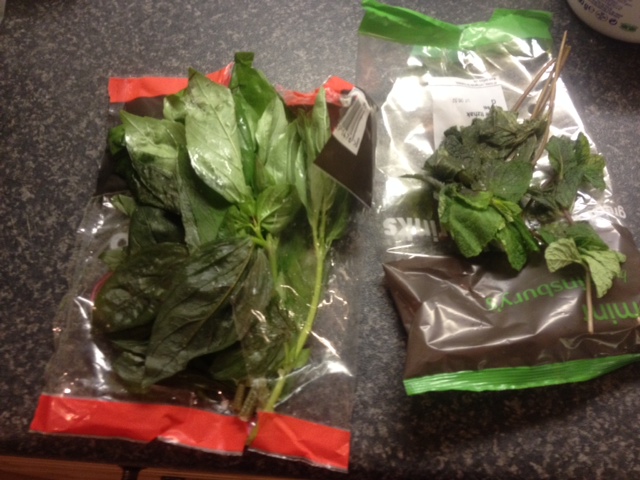
Despite the packaging on the Basil clearly reading “keep me away from the cold”, the packet of Basil had ended up squished in the bottom of the fridge past it’s prime, alongside a few sprigs of floppy mint and some wrinkly cherry tomatoes.

image

Normally when I have left over Basil, I make myself some home-made pesto and as I only had a few sprigs of mint left, I decided to throw them in. I’ve never made any other pesto other than bog standard pesto but I’ve heard adding mushrooms, mint and a whole other host of ingredients can create great variations on the original.

I couldn’t remember the correct measurements so I just threw all the herbs into a blender with two tbsps of toasted pine-nuts, a crushed garlic clove and a good glug of olive oil. I always find pesto takes a while to blend, during the blending I gave the mix an occasional stir and gradually added more olive oil until I was happy with the consistency.

After I tipped the mix out of the blender for a taste test, I discovered my hap hazard approach to pesto making had led to me missing out a vital ingredient…parmesan.

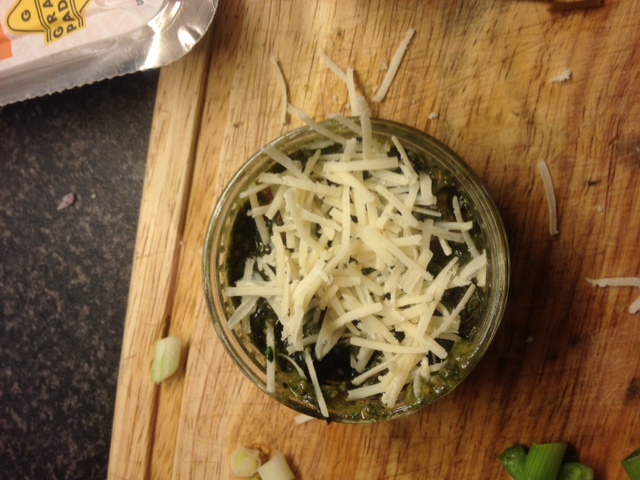
Not wanting to re-blend, I just added grated parmesan to the finished product (probably not how the Italians do it but hey-ho it tasted pretty good).image-3image-4

 The best thing about making any paste from fresh herbs, is that it pro-longs the life of the herbs and can be used for a huge variety of dishes such as pasta sauces, meat marinades or salad dressings.

I decided to go for the old BBQ classic of grilled halloumi and cherry tomatoes, a proper recipe for which can be found at bonappetit.com.

As I didn’t have a BBQ, or any skewers, I continued with my hap hazard approach to cooking by throwing halloumi and cherry tomatoes into an oven-proof dish, and whacked them underneath the grill for 5 minutes before mixing with the pesto.

And hey presto,  a few wrinkly past their best ingredients created a great dish that can be eaten as an appetizer or lightish supper/salad.

image-1

Caerphilly Cheese Scones

On Saturdays’ check of the fridge, I discovered a whole host of dairy products dangerously close to their use by date. A couple of eggs, the remnants of a yoghurt pot and a whole block of Caerphilly cheese that I’d bought (despite all my own advice) in a BOGOF offer.

Lacking in inspiration, the only meal idea I could come up with was a cheese omelette and a high cholesterol omelette at that. Also, following a rather unhealthy few days of eating out, the thought of a cheese filled week was filling me with indigestive dread.

But a quick google search  came to the rescue showing  me that caerphilly cheese and eggs are the perfect base to a delicious batch of savoury scones. I followed the following recipe from  Goodtoknow.co.uk:

Ingredients

  • 200g (7oz) self-raising flour
  • Good pinch of cayenne pepperImage 5
  • 100g (3½oz) butter
  • 125g (4oz) Caerphilly cheese, grated
  • 3 spring onions, trimmed and finely chopped
  • 2 medium eggs, beaten
  • 2 level tbsp plain yogurt

The best thing about the recipe, was that I had all the items (except the spring onions) already in stock. I opted to buy a bunch to use later in the week,  but I’m sure the scones would still taste great without them.

Now I’m not much of a baker but even for the me the recipe was super simple to follow:

Method

  • Set oven to Gas Mark 6 or 200°C. Sift flour and cayenne pepper, into a bowl. Rub in the butter until it resembles fine breadcrumbs.
  • Add just over three-quarters of the cheese and the chopped spring onion, and mix well. Stir in the eggs and yogurt. The dough will be very soft. Knead very lightly on a floured surface.

I got to the breadcrumbs stage pretty quickly:

Image 1Image 4

However, I was uncertain about the consistency of my  dough. It was super sticky but rather than adding more flour to the mix, I just made sure my work surface and rolling pin was super floured and rolled extra gently.

Image 3

  • Pat out dough to about 2.5cm (1in) deep and cut out 5 rounds. Knead the trimmings and pat out, then cut out another 2-3 scones. Put the scones on the baking sheet and sprinkle with the rest of the cheese, and more cayenne, if you like.

I’m also not sure I’m very good at measuring as my scones certainly weren’t 1 inch deep.

Image 6

  • Bake for 20-25 minutes. Best served warm with butter and a sliver of cheese

Despite the sticky dough and my inability to measure, the scones turned out super fluffy and light and are a great snack sized portion.

Image The best thing about the scones is that they can be frozen, so 3 ingredients on the edge of their use by date have now become a great savoury snack to be eaten at a later date.

I also can’t wait to sample Goodtoknow.co.uk suggestion of having them as a savoury meal with some poached egg and spinach.

And, if you’re wondering what happened to the rest of the block of cheese and remaining spring onions, I discovered a delicious recipe for some Caerphilly Cheese & Leek Pancakes where I substituted the leeks for the left-over spring onions and half a red onion that I found in my fridge.

So from potential food waste came 2 delicious meals, all costing pennies in additional ingredients, and no boring omelette in sight.