Ice Ice Baby – Freezer Benefits

In an earlier post, Sausage, Chilli & Tomato Pasta, you probably noticed that a lot of the ingredients I used had been frozen.

Now I’ve spent a large proportion of my adult life in shared housing where I’ve had to store my entire grocery shop on one lonely fridge shelf, and freezer space was nothing but a luxury to dream of.

It’s only in the last couple of years where I’ve had the very grown up pleasure of not only my own flat but also access to a fridge & freezer that’s all mine.

The benefits of having a freezer came instantly, I was suddenly allowed to take advantage of supermarket offers that I never could before such as Sainsbury’s meat, poultry or fish 3 or £10 which is one of my most purchased offers.

Batch cooking and the ability to freeze leftovers has also been a huge benefit. If I cook 4 portions of Spaghetti Bolognese, no longer do I have to spend an entire week eating it as the wonders of Tupperware mean I can freeze it for a later date. For days when I’ve got caught back late at the office, it’s great to come home, not have to cook and still be able to eat a nutritious home cooked meal that’s awaiting me in the freezer.

Recently, since I embarked on my food waste frenzy, I’ve started to freeze even more stuff, not just fresh meat and leftovers. Half of the stuff I wasn’t even aware you could freeze.

Ice cube trays have become my new found friend, I’ve used them to freeze home-made stock, the left-over dregs of an unfinished wine bottle and the end of bunches of those pesky supermarket herbs which never get used up in one portion. Once frozen, you can tip the ice cubes of stock, wine etc. into a freezer bag, label up and keep until a later date when a recipe calls for the ingredient. Freezing items such as stock & wine, not only stops you throwing left-overs out, it reduces the need to buy big packets of these ingredients when a recipe only calls for a small amount.

In my experience, a lot of what you do and don’t freeze comes out of habit, for example I’d never thought to freeze items such as butter and milk but I’ve tried both recently with no adverse effects. The butter I’d taken advantage of a 2 for 1 offer and the milk I’d picked up a couple of pints only to arrive home to find my partner had done the same. In days gone by, both of these ingredients would probably have lingered on my fridge shelf, past their best and been confined to the bin, but the freezer came to the rescue.

Other items I’d never dreamed of freezing were fresh fruit & veg, but my foray into food waste has taught me that a lot of fresh fruit & veg can indeed be frozen with little detrimental effect on the ingredient. So far I’ve frozen chillies, celery, lemons and peppers. The advice seems to be in all instances to chop up the veg first and then freeze in freezer bags. The ingredients probably won’t be up to being used in a nice fresh salad but for stews & stir-frys etc. I haven’t noticed any negative effects on the flavour or the texture. I suppose if you think logically, you can already buy a lot of frozen vegetables so what’s the difference in doing it for yourself.

If you’re unsure about what you can and can’t freeze, Google and the blogging world will come to your rescue. As mentioned the positives of this are not only reducing waste, it also helps to reduce costs as you’ll have ingredients on hand and not have to buy new over-sized packets of stuff and you can take advantage of those supermarket offers that I generally advise against. I’ve also found that I do not have to visit the supermarket quite as often as I regularly find that I have enough ingredients in my freezer to knock up an ad-hoc meal on demand. So don’t be afraid to get cold and get freezing, hopefully you’ll start seeing all the benefits that I have

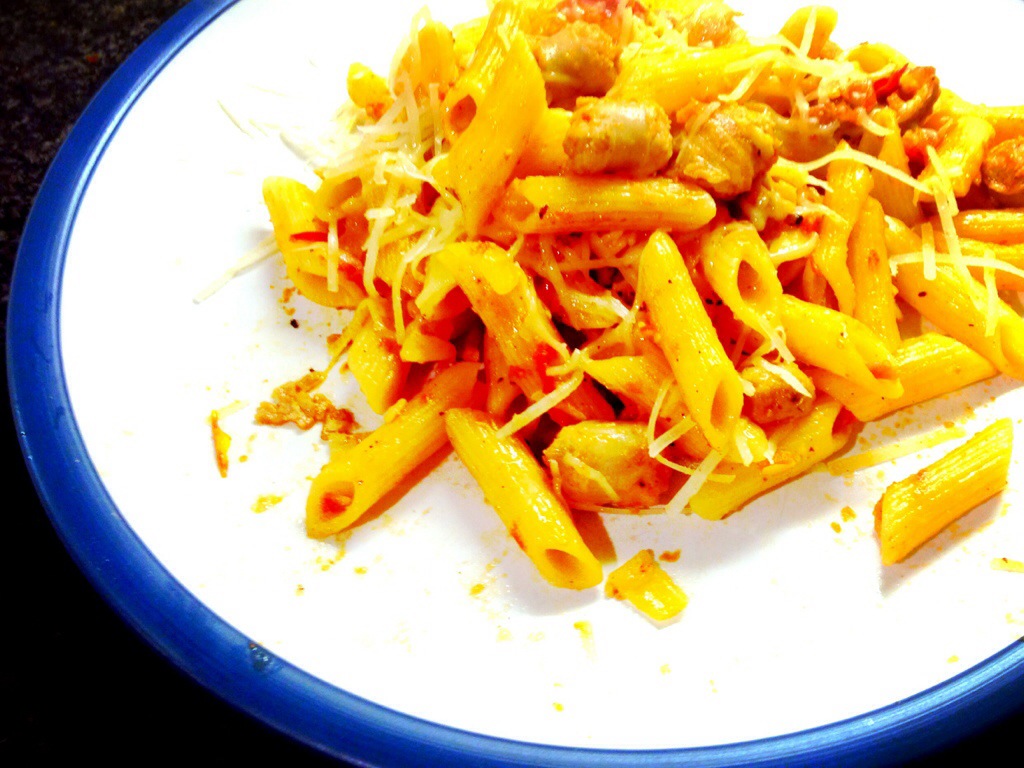
Sausage, Chilli & Tomato Pasta

This week I’m home alone; when I’m home alone I never want to spend much time cooking so I prefer to make a couple of dishes that will serve me over multiple meal times.

I’ve had a rather extravagant January and with the Christmas costs still hanging over me, I’m determined to have an economising month. My mission during February is to literally empty the cupboards and freezer and buy as little as possible from the supermarket.

Last week I’d frozen some leftover tinned tomatoes and some fresh red chillies; also lurking in the bottom of my freezer were some pigs in blankets that I hadn’t used up over Christmas. I couldn’t think of a use for the pigs in blankets other than on the side of a roast, but I figured that they’re just sausages and bacon so why not use them up just as I would normal sausages.

Pasta’s great for using up leftovers, it’s amazing what you can do with tinned tomatoes and a few veggies, there’s no need to buy expensive jars of pasta sauce. As I was using up ingredients I had in the freezer and cupboard I didn’t have to visit the shop for this recipe as there was also a half eaten onion lurking in my fridge.

And this is how the ingredients below, provided me with couple of dinners and a lunch for the week (there would have been 4 portions but I didn’t have quite enough pasta in) meaning that I didn’t have to slave in the kitchen every night after work.

20140209-145324.jpg

INGREDIENTS

  • 6 Sausages (I used pigs in blankets as a substitute)
  • 200g Tinned Tomatoes
  • 200-300g Pasta (50-75g a portion)
  • 1/2 Onion
  • 1 Red Chilli (or pinch of dried chilli flakes)
  • 1 Garlic Clove
  • 1 tbsp Olive Oil
  • Dash White Wine (optional)
  • Parmesan to top (optional)

METHOD

Heat oil in large frying pan and fry chopped onions and garlic for 3-4 minutes until soft

Add sausages and fry for 5-6 minutes until browned

Add dash of white wine (water or stock will do if you don’t have wine) and scrape the bottom of the pan (this step will add additional flavour to the sauce). Boil over a high heat for a few minutes, until the liquid has reduced by a third.

Add in the tinned tomatoes and chopped red chilli, bring to the boil and then simmer for 10 minutes or until the sausages are cooked through.

Meanwhile cook the pasta according to the instructions. Once cooked and drained, combine with the sausage mixture and top with grated cheese if desired.

20140209-144026.jpg

TIPS

Note I used frozen fresh red chillies for this recipe; I’ve found the best way to freeze chillies is to chop before freezing. I’ve frozen chillies whole before but they tend to retain too much water when defrosted.

The dash of white wine I used was also frozen. If you have a few dregs of wine remaining (sacrilege), freeze in ice cube trays and these can then be used for cooking, as recipes require.

Leftover pasta is a great thing to pack in some Tupperware and take for lunch; it’s also suitable for freezing if you don’t want to eat all the portions in the same week. (Homemade ready meals).

Sweet Chilli Salmon with Asian Vegetables

Salmon is one of my midweek time saving meals. It’s quick to cook, can be served with pretty much any side and gives rise to a huge variety of optional flavour mix ups; from simple lemon and parsley to teriyaki salmon or something more unusual, such as sweet chilli.

The idea for this dish was again down to leftover ingredients mentioned in my No Shop Week blog, which included fresh salmon fillets that I’d frozen alongside carrots and green beans.

The vegetables screamed stir-fry at me and Asian flavours are so easy to achieve with a few stock cupboard essentials.

If you’re a fan of Asian food, I’d recommend always keeping in store soy sauce, sesame oil, honey and; a new discovery on my part; ginger paste (although only buy this if you will use the paste regularly as it does have a shortish self life when open). In terms of flavour, I prefer fresh ginger but I like the fact that keeping paste in stock, opens up the opportunity to throw together a huge variety of Asian sauces without having to visit the shop.

I’m a flavour junky and I knew I wanted to stir fry the vegetables with sesame and soy but I didn’t want the salmon to be bland so I coated it in sweet chilli sauce, covered it in foil and baked in the oven for 15 mins. Whilst the salmon was cooking I prepared the veg, chopping the baby carrots and green beans into long thin slices.

In a wok, I heated a tbsp of oil and fried a clove of crushed garlic with a tsp of ginger paste for a minute, before tossing in the veg. I then added a tbsp of sesame oil and 2 tbsps of soy sauce and stir fried for a further few minutes before serving with the salmon. And that’s how to quickly make great Asian style side.

(Again I’m not one for measuring, as a guide two to one of sesame vs. soy is a good start. Sesame oil is very strong flavoured so I tend to start small and adjust as I taste)

If you fancy some carbs, this dish will be great with rice or why not flake the cooked salmon up and stir fry with the veg and a portion of egg noodles.


20140206-224026.jpg

Pork & Potato Broth

In my previous post No Shop Week,’ I promised to write up the recipe for this dish which was made solely from left over vegetables, frozen items and stock cupboard items…no supermarket visit involved. This recipe is a great example of how knowing the base of a few simple dishes can really help to reduce food waste.

The perishable ingredients that I had to use up were:

Celery

Potato

Carrots

Onions

Ingredients in the freezer included:

Pork mince

And store cupboard essentials that I had in stock were:

Vegetable stock

Worcester sauce

Chilli sauce

Ketchup

Garlic

The idea for this recipe came from my hate of celery. I’m really not a fan of raw celery, in my opinion, anything that contains less calories than it takes to eat isn’t a food. The only time I ever use celery is in stews and soups, which are conveniently both fantastic recipe ideas for using up leftover veg.

Now I could have cooked a simple soup out of my leftovers and for you vegetarians out there, feel free to adapt this recipe by leaving out the pork, or if a thicker blended soup is more your bag, throw in a few extra potatoes and blend before serving.

Anyhow, back to the pork…

I know how long most veg takes to cook, and this is what dictated the order of which they were added into the pan, so if you’re using different vegetables, follow this methodology to work out your timings.

For this specific recipe though, here we go with the method:

  • Heat 1 tbsp oil and fry onions for 2-3 mins until soft
  • Add pork and fry for 4-5 mins or until browned
  • Add chopped celery and fry for a further 2 mins
  • Drain off some the fat from the pork, this will avoid a scum forming on top of the broth
  • Add stock (see notes) and bring to boil. Once boiling reduce to a simmer, add diced potatoes and cook for 5-7 mins
  • Once the potatoes start to soften add in the chopped carrots and continue to simmer for a further 3 mins
  • Finally add Worcester sauce, ketchup and seasoning to taste

Tip

If you don’t like your vegetables quite as al dente as me, feel free to keep simmering until they are cooked to your liking.

And that’s it, a quick simple broth from leftovers.

20140206-211721.jpg

In terms of the measurements I was unsure how much stock to use. 250 ml per portion sounded like a reasonable amount and I wanted 4 portions so I made up 1 litre of stock.  When I came to add this to the meat, it just felt like too much so I reckon only about 800ml went in.

The trick with inventing dishes and also when following other peoples recipes, is to follow both your instinct and your taste buds. Don’t be afraid of messing up dishes by adding too much of an ingredient or diverging away from a recipe. If you’re unsure of how much of a particular ingredient you should add, start with a smaller quantity and keep adding until you’re happy. In this instance I started with 1 tbsp of both ketchup and Worcester sauce and continued until I was happy with the flavour. In total about 2 tbsp of ketchup and 1.5 tbsp of Worcester sauce went in.

I mentioned in my “No Shop Week” blog, that knowing a few basic recipe bases & tips will help with inventing dishes. My tip to take away from this recipe is that adding ketchup and Worcester sauce to casseroles and soups is a great way to add flavour without having to buy any extravagant sauce mixes.

Believe it or not, Ketchup is a fantastic ingredient to sweeten up dishes, Worcester sauce adds a bit more depth to stocks and stews with its unusual and unique taste, and although not used in this recipe; if you like things spicy, Tabasco/chilli sauce is an easy way to add a bit of a kick to recipes.

Every Last Crumb

A week or so ago, I saw a lot of twitter debate about the BBC Food and drink programme entitled Every Last Crumb which involved Michel Roux and Mary Berry offering their own food waste tips. One of the main areas of debate was that more expensive food keeps better and that if food were more expensive, we would waste less. I disagree with this, I personally agree with Michel Roux, who argued that regardless of how much food costs; the attitude to wastefulness is the most important factor in reducing food waste.

Mary Berry who lived through rationing, argued that the reason the younger generation waste more food is down to lack of education and in part I’d agree with this. I’m a self-taught cook, who has learnt how to use up various ingredients through trial, error and experimentation but at the same time I don’t ever remember my mum throwing anything away. Roasts were made to last a couple of days with the left-overs served up on a Monday, the dark meat that no-one wanted to eat was thrown into a curry and a large proportion of the weekly shop went straight into the freezer to ensure that the food was preserved as long as possible.

In part I think that some of the problem comes from the huge choice and availability that we have in supermarkets. As a child dinner was generally meat and two veg, dishes that didn’t require huge amounts of ingredients. The food revolution and the abundance of TV cookery programmes has meant that people have become much more inventive in the kitchen. The problem with world cuisine and restaurant quality dishes is that they often require multiple unusual ingredients that can’t necessarily be used in every day cooking. The act of planning one meal at a time hinders the ability to reduce food waste.

This is where meal planning comes to the forefront of reducing food waste and it was great to hear Mary Berry talk about this. The action of looking through your fridge weekly to see what needs using up and planning a meal with these ingredients before heading out to the supermarket is the key to ensuring that the majority of perishables are used up.

Another key point that came out of the programme was that it’s perfectly acceptable to substitute ingredients. If a recipe calls for a particular cheese or herb, there’s nothing wrong with substituting that ingredient with something that you already have in stock. This is something that I do regularly, for items such as dried herbs, a quick Google will tell you what alternatives can be used for something that you don’t currently have in the kitchen cupboard. Here is a great table to get you started. For shallots I use onions; sometimes a stir-fry calls for chicken but I only have beef or pork in the freezer, the list is goes on. This might not be how it’s done in restaurants and it might alter the taste of a dish slightly but remember restaurants are cooking for multiple diners and buy only the quantities they need. Before you buy a large batch of a particular ingredient ask yourself will you use it? If not, can it be substituted?

Regardless of some of the debates that the programme raised, it’s great to see prime time TV putting a focus on how to reduce food waste. It’s not just the BBC giving airtime to the issue; Channel 4 is now in its second series of Jamie’s money saving meals, where recipes are made from leftovers, the show is also filled with tips on substituting & preserving ingredients.

Also in the media is Sainsbury’s make your roast go further campaign, championed by the wonderful Jack Monroe. With this increasing focus on thriftiness and wastefulness, hopefully attitudes and habits to food waste will change, as we are all capable of making small changes that will help reduce the growing problem of food waste.

No Shop Week

One of the fundamental factors of reducing food waste is to plan meals in advance before heading out to the shop. I’ve written about how to do this before in my blog post Fail to plan, plan to fail (the basics of meal planning).

This is probably the one thing that I do consistently every week. Even if I haven’t written the whole meal plan down, the ideas and ingredients are in my head before I go off on my weekly shop. The meal plan makes sure that I avoid the purchase of any unplanned items which later become items of food waste.

Now I’m not a chef, so I generally rely on other people’s recipes to help me use up the ingredients which I have in stock. This method of meal planning normally means that I need to buy additional items to create a finished dish. However, as it’s a new year, I’ve decided to be a bit more adventurous and create my own recipes where ingredients enable me to. An unexpected bonus of this is that I didn’t have to step foot in a supermarket for a whole week.

By using frozen items, leftover veg and store cupboard essentials I managed to create enough dishes to feed my partner and I all week.

The ingredients I had were as follows:

Frozen items
Pork mince
Salmon
Leftover Caerphilly cheese scones

Fresh items
Green beans
Baby carrots
Celery
Tomatoes
Potato
Coriander
Tomatoes

Store cupboard essentials
Ginger paste
Soy sauce
Worcester sauce
Sesame oil
Ketchup
Stock
Eggs
Cheese

And the Dishes created are as below: (Now linked to the recipes)

Pork and Potato Broth
Sweet chilli salmon with Asian Vegetables
Caerphilly cheese scones with poached egg & tomatoes
Cheese & tomato omelette

I know there’s only 4 nights recipes here but I was lucky enough to be treated to a meal out one night, hence only 4 week night meals to plan.

I found that knowing how to cook the base of a number of dishes such as casseroles and Asian dishes enabled me to be creative. Keeping in stock cupboard items such as chicken stock, soy sauce and so on, you should be able to come up with a few creations to use up the perishable ingredients in your fridge. Heck, it’s not always going to work out perfect, but taste as you go and over time your confidence will increase and become a chef if your own right.

Horror of the herbs

Fresh Herbs are probably one of my biggest items of food waste.  I’ve tried to grow my own but I’m not very green fingered and a top floor flat with no outside space, doesn’t seem to provide optimal growing conditions.

Where possible I try to substitute fresh herbs for dried but for lots of recipes dried herbs just don’t quite cut it. The shelf life of shop bought fresh herbs is extremely short and I find the packaged quantities just far too large to use up in one meal. More often than not, on my weekly clean up of the fridge, there’s normally some black coriander or some shrivelled parsley that’s headed for the bin.

I’ve got quite good at making pesto, a great use for left over basil.  There’s also a whole variety of  other condiments and dressings that can be made from various herbs. Fresh herbs can be mixed with oils to create marinades for meat or added to dairy products such as butter and cream for a bit of a twist.

Despite these ideas I still manage to incur an abundance of throw away herbs each month and so I decided to turn to the internet to research what other options are available. It transpires that there’s a whole host of ways to extend the life of herbs. You can freeze them, dry them, infuse oils with them and so on…all ideas I’d never have thought of. Hey, there’s even websites dedicated solely to care and storage of fresh herbs.

These ideas aren’t my own but there’s so many websites, including wikihow that show you how to do all of the above ideas. I think my preferred option is the freezing idea and although this takes away freshness and means that the herbs can’t be used for garnishes, I imagine that the herbs would still taste fantastic mixed into many dishes.

So after a little bit of googling I now have many herby experiments to try and can hopefully reduce my food waste even further. I’d be really interested to know if anyone’s tried or tested the freezing of herbs, or better still if any readers out there have any additional ideas of how to use up these pesky leftovers?

Turkey and Potato Bake – The Last of the Turkey

6 days into Christmas and the turkey battle ensued  but we were finally down to the last couple of portions of the 5kg turkey. Other ingredients left over from Christmas day included half a bag of potatoes and a pot of double cream. Being a big fan of dauphinoise potatoes I decided to use this as a base for the final turkey throw down.

First of all my sous-chef (aka Mr Foodwaste) par-boiled 4 potatoes for 10 mins and left to cool. Whilst they were boiling I fried up an onion for a couple of minutes in a large saucepan before adding the last pieces of turkey. After a couple of minutes I added a good glug of white wine (a half open bottle that shock-horror, we’d somehow failed to finish). This was simmered at a high heat until it had reduced slightly before the leftover cream was added (I probably had about 200ml left). I also added in some chicken stock to ensure all that all the turkey mix was covered and to slightly thin out the creaminess. For a bit of extra flavour I threw in some leftover thyme.

After bringing the mixture to a boil and simmering for 5 or so minutes I added the leftover cranberries and simmered for a further 5 minutes before seasoning to taste. The sauce was incredibly rich and the cranberries quite bitter so I was a little concerned about how the dish would turn out.

Using a large casserole dish I thinly sliced potatoes and layered on the bottom of the dish before adding a layer of the turkey mix. I continued the layering until all the turkey mix was used up, finishing with a layer of potatoes. For extra creamy goodness I’d recommend saving some of the liquid from the turkey mix and pouring over the bake which will then filter down through all the layers.

For an extra bit of fatness I topped the bake with a few small slices of camembert cheese before placing in  the oven (200c) for 40 minutes by which point the bake had turned a beautiful golden brown.

The oven baking seemed to have taken away some off the richness from the initial mix and the bitterness of the cranberries had reduced as well. All in all the dish was a very calorific winner, so much of a winner that Mr. Foodwaste couldn’t wait to tuck in, leaving me with a picture of a half eaten dish.

photo

Turkey Soup – Asian Style

I mentioned in my Too Much Turkey? post that I’d received some beautiful Japanese ramen bowls as a gift from a very kind sister. So with left-over turkey and some new bowls to use a, turkey ramen seemed like a must make.

The best thing about making this was that I didn’t even need to pop to the shops as christmas leftovers and store cupboard items granted me all the ingredients needed.

My boyfriend has decided to get in on the whole food waste thing and he had made a delicious stock from the turkey bones the previous day. To make stock, simply chuck all the turkey (or any meat bones) in a large sauce-pan with a carrot, onion and a couple of celery sticks (the veg is fine-cut into big chunks, and there’s no need to peel the carrot). Top with water, bring to boil, pop on a lid and simmer for a few hours, skim off any scum that collects on the top of the pan during the process. Once the liquid has reduced by about a third, sieve into a container or another pan and hey presto homemade stock.

photo 2-1photo 5

Now I didn’t follow a recipe for the ramen but I cook a lot of Asian style food where the base commonly contains ginger, garlic and chilli, all of which I had in stock. Heating a tbsp of olive-oil in a large saucepan I fried the garlic, chilli and ginger up for a couple of minutes, before adding the leftover turkey. This is a great recipe for getting rid of some of the darker, tougher meat as it adds more flavour and the turkey softens slightly as it flakes up in the soup.

After about 3-4 minutes I added in the pre-prepared turkey stock and gradually brought to the boil. I’m never sure on how much simmering time to allow but as my stock was already marvelously rich and the turkey already cooked, I figured 20 minutes of a low simmer would be plenty of time to allow the flavours of chilli and garlic to infuse into the stick.

Normally in an Asian soup I’d add in vegetables such as bean sprouts and Pak choi but my Christmas leftovers consisted of baby carrots and fine green beans so in they went.

I chopped the chantry carrots into lengthways slices and added into the simmering stock for 5 minutes before adding the fine green beans in  for the last two minutes. The final step of the stock was to add in a couple of tablespoons of soy sauce and a dash of white wine vinegar to taste.

Whilst the stock was simmering I separately boiled  and de-shelled two eggs (medium/hard-boiled – about 6-7 mins) and some fine egg noodles which were tossed in soy sauce before being added to the soup. The outcome was an absolute delicious and refreshing soup which made me forget I was eating turkey for the 4th day in a row.

photo 5-1

If you fancy recreating a similar soup yourself, it will work well with most leftover meats, especially chicken and pork. If you don’t have the bones or the time available to make your own stock, shop bought stock will do just fine. Also any vegetables can be added, whatever’s left over in your fridge, just adjust the cooking time for however many minutes that particular veg takes to cook.

The ingredients I used in my ramen can be found here for inspiration but why not get soupy and go create your own.

 Ingredients

1 x tbsp vegetable oil

1 x clove of garlic

2 x chillies

1x tsp grated ginger

1 x onion

2 x handfuls of cooked turkey

750ml turkey stock

Handful baby carrots

Handful green beans

2 x blocks of fine egg noodles

2 x eggs

Soy sauce

White wine vinegar

Parsnip & Potato Rostis (from left-over veg)

Glancing in my fridge on boxing day I was met with a huge array of left-overs giving me plenty of ammunition for a few experimental dishes.

We’d cooked far too many vegetables to accompany Christmas dinner, a common mistake when cooking up roasts, but being determined not to waste a morsel I’d kept all the surplus in the fridge. Some of the left-over vegetables had made it onto my boy-friends turkey sandwich – ‘a roast dinner sandwich’ (or a manwich in his words), which was pretty delicious but it hadn’t made a dent in the left-over roast potatoes, parsnips and baby carrots.

I’d seen Nigel Slater cook up some Bubble and squeak patties so I decided to do something similar with my left-overs. I mashed up all the potatoes, parsnips and carrots but the mixture was very dry, so for moisture I added a dash of left-over turkey stock and gravy. After adding seasoning, I divided the mixture into 4 (although the number of röstis will depend on how many left-over veggies you have) and moulded into patty shapes which were probably about 1.5cm thick.  I heated a knob of butter in a non-stick frying pan but was unsure of cooking time so I turned the röstis over every two minutes (I find if you turn too often the röstis start to fall apart). After a total of about 8 minutes, they were a nice golden colour and hot all the way through.

The röstis would make a delicious side dish but I also had some left-over stuffing from the turkey which I decided to serve with the röstis. I moulded the stuffing into thin patties, again adding some left-over stock for moisture and popped them in the oven at 200c for 15 minutes. Again I was unsure of timings so I kept my eye on them, the stuffing patties were very moist and I was unable to turn during cooking but after 15 minutes they had dried out and become golden.

To serve, I placed the stuffing ontop of the vegetable röstis and for the final touch I reheated a small amount of leftover cranberry sauce in the microwave. The röstis were absolutely delicious with all the flavourings of a roast dinner, they’d make a great starter or a light supper  and the best thing is that I’m pretty sure they can be made with any left-over vegetables. I’ll definitely be making them next time I cook too much vegetables.

This is the first time I’ve made something out of left-over cooked vegetables and it would be great to hear about what other people do with theirs.